

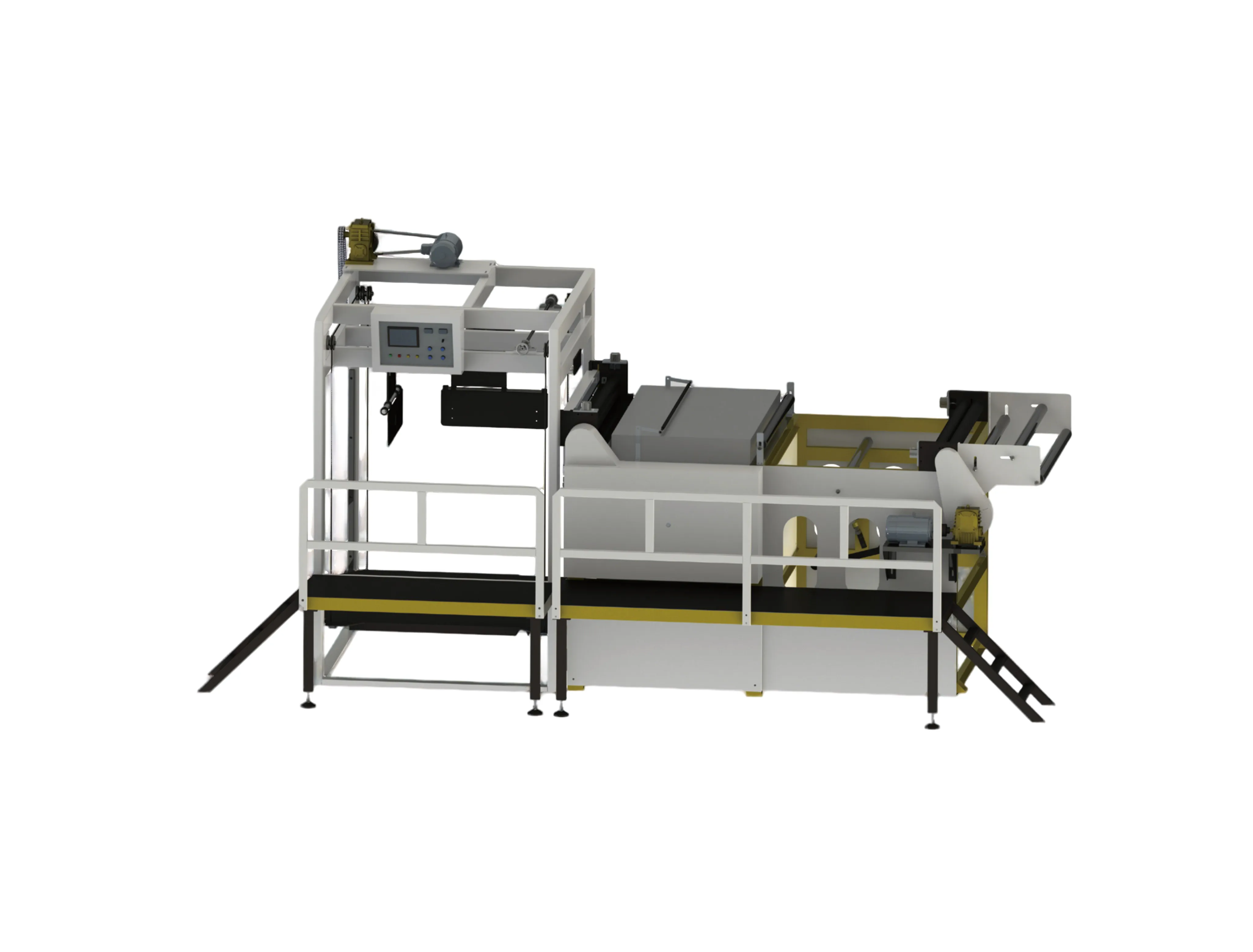
An elevation-type transverse cutter converts paper or board from the feed into sheets of a specified length through crosswise cutting. Yueda's FQN1200 and FQN1400 product information lists feeding diameter, cutting width and length, material grammage and stacking height. These parameters help buyers describe the required job and compare the two models.
The following is a buyer-level process overview. The exact feeding arrangement, controls and operating sequence must be confirmed for the supplied machine. It is not a substitute for the machine manual or operator training.
The job begins with material identification: paper grade, grammage, incoming width, roll dimensions and condition. Check these details against the proposed model and the supplier's application review. Material variation can affect downstream results, so use representative production material for acceptance trials.
The published FQN table gives a feeding diameter of 1500 mm and a grammage range of 60–500 g/m² for both models. These are separate specifications; neither establishes suitability for every coated, laminated or otherwise treated material.
Material advances through the feed path towards the transverse cutting section. A buyer should ask how the supplied configuration supports consistent feeding and how the required sheet length is set and checked. Do not assume a particular sensor, servo arrangement or automatic correction function without configuration documentation.
The name “elevation-type” alone does not establish that the cutting head is height-adjustable. Ask Yueda to explain the relevant structure using the actual machine drawing or demonstration.
The transverse cutting stage separates the advancing material into sheets. The FQN model table lists cutting widths of 1200 mm and 1400 mm respectively, with a cutting-length range of 400–1300 mm for both models. Check the full combination of material, format and operating conditions rather than one limit in isolation.
Agree a trial protocol for length consistency, squareness and edge quality. Published precision or speed values should be reviewed with their test conditions and the intended production material; they are not a guarantee for every job.
Finished sheets move to output handling and stacking. Both model listings specify a stacking height of 1300 mm. Confirm the actual collection arrangement, stack requirements and safe handover to the next process with the supplier.
Check the agreed sample quantity and record sheet quality and stack condition. Keep rejected and accepted output identifiable. The FQN ordering checklist brings together configuration and acceptance questions.
Send paper samples, grammage, incoming roll details, required sheet formats, output targets and available floor space. Ask for a configuration-specific proposal and demonstration where appropriate. All operation, adjustment and maintenance must follow the supplied manual and your site's safety procedures.
Contact Yueda for a process review. Email: peterchen@yuedamachine.com. Contact: Peter Chen, +86 18767458866.
Contact: Peter Chen/Jack Chen
Mail : peterchen@yuedamachine.com
Cellphone: +86 18767458866/ +86 19857780001
Address: Building 2, No. 1333 Times Avenue, Longgang City,Wenzhou City, Zhejiang Province China
Copyright © 2026 Wenzhou Yueda Packaging Machinery Co., Ltd. All Rights Reserved.
SitemapThis website uses cookies to ensure you get the best experience on our website.
 Español
 Portugues
 Indonesia
 Tiếng Việt



 Phone
 E-mail
Comment
(0)